Monday, 16 September 2013

Environmental Sounds can cause certain feelings to arise


What are the sounds we hear in our immediate environment? 

The key concept that emphasizes this inquiry is Causation. Through engaging this Concept and asking questions, the children gain an understanding that behaviours or actions have consequences and reasons.


Sounds can be perceived differently and can cause different feelings in each individual. 


 Trystan hears the "school bell"; its meaning is to inform the children that recess started or that recess is over. The children express their understanding of this sound by responding to the meaning by going outside or inside the school. 

Alexis  was able to hear sounds from the main area in the school. She heard, "Children singing the song, 'Oh, we are going walking'". This sparked an interest in Alexis to explore different folk songs and their specific forms. 

Jason heard "Instruments" making sounds and playing music in the cubbies. This took his thoughts on a ride back home, thinking of his "brother playing piano. It feels good to hear my brother play the piano". This idea will lead to another line of inquiry: Environmental sounds are used to express feelings and thoughts.

Roy heard "people talk and sing folk songs". People express themselves in different ways and one way is definitely through different SOUNDS that cause different meanings, thoughts and feelings. 

Maddi, Bela and Sofia hear Instrument sounds and Songs that caused their bodies to want to move. They all danced and twirled around the room. Happiness and Cheerfulness arose from this action. Maddi likes to dance and listen to the instruments from a song that she heard in Hawaii: "The Ulalena Rain Song". 

Tuesday, 10 September 2013

Formative week – How do we express ourselves – Sound travels


How do we experience sounds?  

Saddling ourselves on a new adventure we began our next inquiry. Our new unit is based on the sounds that surround us. We will explore ways in which to use sound in order to express our thoughts and feelings. In the formative week, the children share their knowledge about the new unit, "Sound travels".

The children experienced sounds in different ways:

Animals make sounds: 

Sofia "Squeak, squeak" (Mouse)
Maddi " neigh, neigh" (Horse)
Trystan "Chirp, chirp" (Bird)
Bela 'The hopping of a bunny sounds like somebody is stepping on some leaves" 
Alexis "Hoo, hoo" (Owl)
Roy "A squirrel moving around makes a scratching sound" 
Jason "Arf, arf" (Dog)

Objects make sounds: 

Blocks “when they crash down” - Trystan
Paper  “When you crumple it up” - Sofia
Bracelet "My bracelet makes jingly sounds when the beads touch each other"  - Bela
  
People make sounds:

“Our fingers tips walking up and down on a table” Sofia explained how that movement and sound makes her think of a dog walking on the road.
“Our mouth, tongue, and teeth make lots of sound” Trystan
“My belly when it is hungry”  Bela

Instruments make sounds:

Drum “bum, bum, bum, bum” – Sofia
Flute “ta-na-na-na” – Alexis
  
***How sounds are experienced is the line of inquiry that we focused on. 

The book that we read is called “The listening walk” by Paul Showers and the children got inspired to go for a walk and listen to all the different sounds that surround them and see how these different environmental sounds cause certain feelings to arise.

What a wonderful way of starting this new unit and how many excited and wonderful ideas we gathered right from the beginning. The children’s knowledge and interest in exploring different sounds sparked a desire to embark deeper into this inquiry!

Wednesday, 12 June 2013

Dramatic expression


Since the children were so stimulated by the forest exploration, they were driven to express their interpretation of the animals in the forest.

Dramatizing is one way that the children in the Wind group chose to play out these topics. We worked as a group and prepared the background and materials needed for the presentation. We wanted the audience to get a better understanding of our perspective and connect to our ideas. All the children feel that being in the forest feels good; it makes them happy, more relaxed. The quiet environment gives them an opportunity to enjoy and observe the surroundings. 
The play took place in the forest (background painted by the wind group children). The characters wore costumes (individually hand-made) and expressed themselves in such a way that the audience would understand what character they had chosen to be. Sofia loves dogs and really wishes that she could have one. Her doggy costume was white with lots of colourful buttons. Emilie was a ballerina walking her dog in the forest (the picture will show the curtsy Emilie did in order to thank the audience for watching). Sofia wiggled her tail to express happiness. Howard was a red dragonfly, flying from tree to tree. He loves dragonflies because they are "… very fast and one time, a dragonfly flew close to me and it felt like a scratch." 
Simon was an excited squirrel, nibbling his peanuts.  
Trystan expressed himself through body movement and facial expression. He wanted to connect to the audience in a different way. He wanted the audience to feel scared; this is the way he feels when he thinks of bears. He is always asking everybody to "… care for bears and their environment. We share the forest with them and we need to protect their home."
Byron's presentation was on a different topic. He loves games, especially because they bring him together with his friends. He is very interested in cars. "I like that cars are fast". He is happy when he plays with his friends so this is the feeling that he wants to express.
 
What a delightful presentation, full of love, creativity, expression and audience appreciation. 

Individual assessment (“How will we know what they have learned?”)


Assessment is the process by which we determine what the children have learned throughout the unit. We employ different strategies to determine what connections they have made within the unit as well as making connections to previous units. 

The pictures show the children's individual assessments and their knowledge. 


Creative Expressions - Varying Environmental Context


Trystan really enjoys playing in the forest. "Climbing trees makes my heart jump up and down sometimes". All the children in the wind group felt a connection to Trystan's experience. They all agreed that the environment plays an important role in influencing our moods and feelings.

The children closed their eyes and focused their attention to the forest, the trees, and the animals. This is what they noticed: 
Emilie “I can hear the birds chirp”
Simon “I can hear the woodpeckers”
Sofia “I feel like dancing”
Byron and Howard “The sound of the cars passing by is what we can hear”
Trystan “I like bears, so I like to listen for a rumbling sound. Maybe we’ll see one”

Afterwards, the children explored the forest on and around the trail. Here are a few examples of how they connected with their environment:

Emilie was balancing on the logs. 
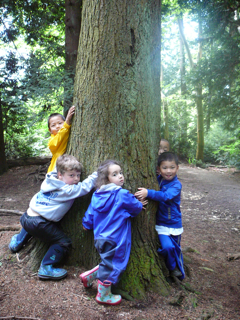
Simon, Byron and Howard were mesmerized by the trees and began to climb them.
Sofia was enjoying listening to the birds, dancing to their song and hugging trees.


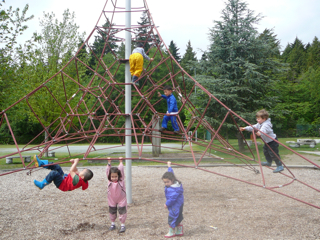
After enjoying the serenity of the forest, the fresh air after the rain, and the birds singing, we moved to the playground. The playground is another place the children like to spend their time. 
At the playground, they all described the ways in which their actions and activities reflected their environment. Simon noticed, "We all do the same things at the playground". The equipment and the environment can put boundaries in people's lives and on their options of expression.
In the end, we all agreed that, the forest is a more open environment in which everybody can freely connect with and interpret the surroundings. At the playground, we feel that the structures place boundaries and guide people towards certain forms and styles of play, limiting their potential for free creative expression. "Magic" is how Sarah and Emilie described the forest after our exploration.  

Monday, 13 May 2013

How we express ourselves when we feel EXCITED

-->

When excited, Trystan, Simon, Sarah and Emilie make a silly face and have a lot of energy. 


Sofia mentioned that she loves to “jump up and down and say Yaay Yaay” when she is excited!

Sarah said that playing in the forest with her friends makes her feel happy and very excited, or as Sarah said, "full of energy and lots of fun."


Throughout the unit, we will explore more ways of expressing ourselves, as well as the messages that facial expressions can give to other people.

While playing in the forest today, Sarah identified that sometimes people might feel one thing, but express something else. Her friend used unkind words and an angry facial expression when she gave her a message. With her teacher’s help, Sarah talked to her friend and asked her to use kind words. Sarah noticed that her friend changed the way she gave the message, but her facial expression was still showing that she was feeling frustrated and angry. Simon added to Sarah's story that “Sometimes your body or face might express happiness, but your voice might sound like you are being sad.”


The children took the initiative to observe their friends and to record different ways of expressing themselves. We will be taking pictures and preparing a slide show that will show different ways of expressing and the connection/influence it might have in our life.

How we express ourselves when we feel SAD and WORRIED

-->
Sofia expresses sadness by wearing a frown and by sighing.


All the children said that they express sadness by crying. 
Some of the children have family members away, so they feel a little bit sad. They all want to say hello to all those who are away and that they will miss them. Sarah mentioned that when she misses someone, she tends to read a book by herself or draw a picture.